
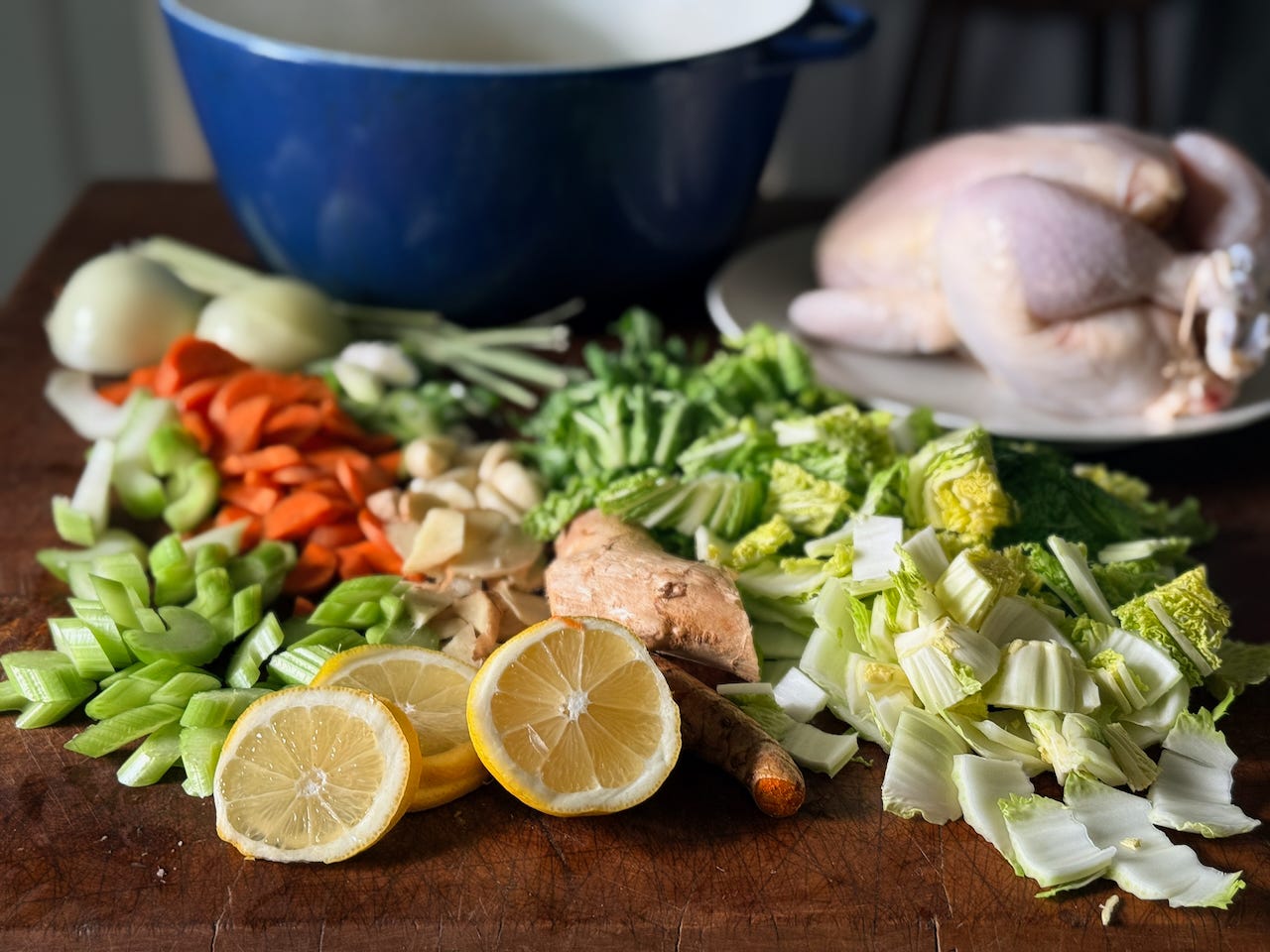
I usually don’t fall for viral food trends, but when Instagram started feeding me video after video of people making a most-intriguing “no-water chicken soup,” I stopped scrolling and started paying attention.
I learned that the simple, satisfying dish originated in China, where it’s often referred to as “healing soup.” Traditionally, a whole chicken is added to a large, heavy pot atop layers of chopped cabbage, onion, apple, carrot, ginger, and sometimes red dates or goji berries. There is not an ounce of added liquid, but after simmering the soup gently for between 90 minutes and two hours the result is a tender braised chicken and condensed broth that, because it’s undiluted with water, is particularly rich in flavor and nutrients.
How could I not give this a try? (Let’s acknowledge that while it’s almost mid-May, at least here in the Northeast it’s still very much soup season. Sigh.)
I thought about what I wanted my no-water soup to taste like and decided to forgo the apple and goji berries in favor of additional aromatics—scallions, garlic, and lemon. I also added turmeric—both for its anti-inflammatory properties and its glorious golden color.
In at least one video, the soup is served with ginger-scallion sauce, a common accompaniment to poached or braised chicken in Cantonese cooking, and since I adore this simple condiment, I whipped some up and I’m including the method below. (I’ve made a version of it for years to go with David Chang’s Momofuku Bo Ssam.)
So how did it turn out?
I had a couple of worries going into this cooking project: One was that the veggies might burn a little at the bottom of the pot without the addition of liquid. And indeed, there was a little brown fond down there, though it didn’t lend a burnt taste and was fairly easy to clean off.
I also worried that braising the chicken for longer than an hour and a half would yield a “cottony” texture, meaning the meat might end up both super soft with a sort of dry mouthfeel. That didn’t happen, most likely due to the very slow braise.
I will say, the first time I tested this recipe I used a spectacular local chicken, and the second and third times I used organic birds from the supermarket, and there was definitely a difference in terms of texture and flavor. Farm-raised birds get more exercise than mass-market ones, so they build up more muscle and connective tissue, which breaks down beautifully with slow cooking leading to a more silky texture than a more sedentary bird. (By the same token, they can get a little tough when roasted.) The local bird also tasted more robustly of…chicken.
My last worry was the most obvious one: Would there actually be soup? The answer is yes…but… not all that much. (The amount of broth varied somewhat with each test.)
There’s a bit of a Goldilocks situation here in terms of cooking the chicken and veg “just right.” Too low a flame and it won’t cook properly in a reasonable amount of time. Too high, and you risk boiling away that nice liquid you’re trying to coax out of the vegetables. Starting low, then moving to a generous medium-low after the first 15 minutes or so should do the trick.
The result is a cozy meal that will easily serve four—especially if ladled over egg noodles or rice, and/or accompanied by a crusty bread and green salad—but there was only enough liquid for each person to have a few good slurps of broth. My friends and family suggested that it was more of a stew, and while I tend to think of stews as involving thicker liquid, in terms of the general look and feel of the dish, I’d agree that it was more “stewed chicken” than chicken soup.
Would I make it again (and again)? Absolutely.
No-waste/leftovers tip: If you don’t use up a whole head of Napa cabbage for the recipe, use the rest to make “Chinese” chicken salad with any leftover chicken, along with some carrot, maybe a red bell pepper, cilantro if you like, and dry roasted peanuts or cashews tossed in right before eating. For dressing, add some rice vinegar, lime juice, and a dash of honey to the leftover ginger-scallion sauce, or use your favorite Asian-style dressing.
Cozy No-Water Stewed Chicken
Resist the urge to uncover the pot periodically to check how it’s going—you don’t want to release all that nice steam. If, after an hour and 45 minutes, you open the pot and there’s very little liquid, the vegetables don’t look stewed, and/or the chicken isn’t very tender, your flame was probably too low. Don’t fret. Put the lid back on, raise the heat a little, and let it go another 20 minutes or so. (This happened to me once and it turned out great in the end.)
6 cups roughly chopped Napa cabbage (more if you have room in the pot)
1 large carrot, sliced into rounds
2 celery stalks with their leaves, chopped
1 medium onion (or a few shallots), sliced
3 scallions, chopped
6 garlic cloves, smashed
1 2-inch piece of ginger, sliced into rounds
1 4-inch piece of lemongrass, smashed with the butt of a chef’s knife (optional)
½ teaspoon ground turmeric, or an inch of grated fresh turmeric
1 teaspoon salt, plus more at the end if desired
Freshly ground black pepper
1 4-ish pound chicken
1 small lemon
In a large, heavy pot with a tight-fitting lid (enameled cast iron is great here), layer the cabbage, carrot, celery, onion/shallots, scallions, garlic, and half the ginger. If you have fresh turmeric, grate it into the pot. If not, sprinkle the vegetables with ground turmeric, ½ teaspoon of the salt, and pepper. Top the veggies with the chicken, breast side up.
Cut the lemon in half crosswise and slice one half into thin rounds. Squeeze the unsliced half over the chicken and vegetables and place it inside the cavity of the chicken. Season the chicken with remaining ½ teaspoon of salt and more pepper. Arrange lemon slices on top of the chicken, along with the other half of the ginger slices.
Cover the pot and cook over low heat for 15 minutes or so, then (without opening the pot) increase heat to medium-low and cook for another hour and a half. If you notice a lot of steam coming out from beneath the lid at any point, lower the heat. It should be simmering gently, not boiling.
Check for doneness: If the chicken is very tender and the vegetables are sitting in a nice pool of broth, it’s done. Remove chicken to a platter, first being sure to hold it over the pot so any liquid runs out of the cavity. Taste broth for seasoning and add additional salt and pepper as desired. Use two forks or a fork and knife to take meat from bones and shred it into bite-size pieces. At this point you can stir it back into the pot or arrange some of it in bowls, top with vegetables and broth, and serve with ginger scallion sauce if desired.
Ginger-Scallion Sauce

Called jiāng cōng jiàng in Chinese, this sauce is usually made with hot oil, which brings out the flavor of the ginger and scallions, but it can be made without heating the oil if you prefer to skip that step. You’ll still have a flavorful sauce.
½ cup neutral oil such as safflower or grapeseed,
½ cup thinly sliced scallions (about 4 thin scallions), white and light green parts, finely chopped
¼ cup grated or finely chopped ginger (from an ounce/about a 2 inch-piece)
2 teaspoon soy sauce
1 teaspoon toasted sesame oil
Heat the oil in a small pot over medium-low heat for about 3 minutes—turn it off if you hear a crackling sound. Test it for doneness by adding a small piece of scallion or ginger. If it sizzles, the oil is ready.
Meanwhile, put scallions and ginger in a heat-proof bowl or measuring cup. Add the hot oil, soy sauce, and sesame oil and stir. Let sit while the chicken cooks so the flavors have time to bloom. Taste for seasoning and add additional soy sauce if desired. Serve with the chicken, and store any leftover sauce in the refrigerator (once it’s cooled).


